Showing posts with label ga. Show all posts

Tuesday, 7 April 2015

Visualisation of evolution

Even though we know that the end result is what we are after, and speed is one of the most important factors, it would be nice when assessing different mutation and breeding operator combinations, and the affect of the applied fitness function to track the evolution of the population, or at least that of the fittest member(s) graphically to quickly see, and convey to intetrsted parties what is happening.
To this end I will explore the possibility of hooking a visualisation interface into the algorithm with a minimum of code churn, and minimal speed impact.
The approach I will take is to use a consumer object to handle the generation complete event. The responsibility of not blocking the processing thread will fall to this consumer, and all details of the rendering of the interim results will be totally hidden to the gentic algorithm itself.  This approach will mean that if a web enabled front end, or simply a different desktop UI, were needed you merely need to construct this and inject it.

I have chosen to use a WPF Gui as I have experience of automatically updating graphs in this medium. Another technology may be better suited to your skill set. The WPFToolkit offers a very good charting control, which can plot data the is updated in real time very easily with data binding.  I will not go into the details of the WPF application itself, or the structure of such an application, however the details of displaying the evolution are what we are interested in, so that is what I will focus on. But I will say that my chosen architecture employed an MVVM pattern

 The code for each chart is very simple, with the UI layer being simply

  xmlns:chartingToolkit="clr-namespace:System.Windows.Controls.DataVisualization.Charting;assembly=System.Windows.Controls.DataVisualization.Toolkit"  
 <chartingToolkit:Chart Title="Fitness" >  
       <chartingToolkit:Chart.Axes>  
         <chartingToolkit:LinearAxis Orientation="Y" ShowGridLines="False"  Minimum="{Binding MinFitness}" Maximum="{Binding MaxFitness}" />  
       </chartingToolkit:Chart.Axes>  
       <chartingToolkit:LineSeries DependentValuePath="Value" IndependentValuePath="Key" ItemsSource="{Binding GenerationFitness}" IsSelectionEnabled="True" />  
     </chartingToolkit:Chart>  

Where the MinFitness and MaxFitness are values calculated as results are generated to give a sensible range for the graph, and the GenerationFitness property is a collection holding the points to plot in the graph. This is bound to a view model that exposes the data without exposing the detail of the GA, and this takes the form:

 class ViewModel: NotifyingObject  
   {  
     private Model theData;  
     private double _minFitness;  
     private double _maxFitness;  
     private double varf = 0.01d;  
     private string _results;  
     private int _delay=0;  
     public ViewModel()  
     {  
       theData = new Model();  
       GenerationFitness = new ObservableCollection<KeyValuePair<int, double>>();  
       GenerationF = new ObservableCollection<KeyValuePair<int, double>>();  
       GenerationR = new ObservableCollection<KeyValuePair<int, double>>();  
       theData.NewGeneration += GotNewGeneration;  
       theData.FinalResults += GotFinalResults;  
       ResetFitness();  
     }  
     public int PopulationSize { get { return theData.PopulationSize; } set { theData.PopulationSize = value; } }  
     public int MaxGenerations { get { return theData.MaxGenerations; } set { theData.MaxGenerations= value; } }  
     public double MinFitness { get { return _minFitness; } set { _minFitness = value; OnPropertyChanged(); } }  
     public double MaxFitness { get { return _maxFitness; } set { _maxFitness = value; OnPropertyChanged(); } }  
     public string Results { get { return _results; }set{_results = value; OnPropertyChanged();} }  
     public int Delay { get { return _delay; } set { _delay = value; OnPropertyChanged(); } }  
     public ObservableCollection<KeyValuePair<int, double>> GenerationFitness { get; set; }  
     public ObservableCollection<KeyValuePair<int, double>> GenerationR { get; set; }  
     public ObservableCollection<KeyValuePair<int, double>> GenerationF { get; set; }  
     public ICommand Stop { get { return new RelayUICommand("Stop", (p) => theData.Stop(), (p) => theData.IsRunning); } }  
     public ICommand Start  
     {  
       get  
       {  
         return new RelayUICommand("Start", (p) =>  
         {  
           ClearAll();  
           theData.Start();  
         }  
         , (p) => !theData.IsRunning);  
       }  
     }  
     public ICommand Clear  
     {  
       get  
       {  
         return new RelayUICommand("Clear", (p) =>  
         {  
           ClearAll();  
         }  
           , (p) => !theData.IsRunning);  
       }  
     }  
     private void ResetFitness()  
     {  
       _minFitness = 0d;  
       _maxFitness = 1d;  
     }  
     private void GotNewGeneration(object sender, GenerationEventArgs e)  
     {  
       Application.Current.Dispatcher.Invoke(() =>  
         {   
           GenerationFitness.Add(new KeyValuePair<int, double>(e.Generation, e.Fitness));  
           if (e.Generation ==1)  
           {  
             MaxFitness = e.Fitness * (1d + varf);   
             MinFitness = e.Fitness * (1d-varf);  
           }  
           MaxFitness = Math.Max(MaxFitness, e.Fitness *(1d + varf));  
           MinFitness = Math.Min(MinFitness, e.Fitness * (1d - varf));  
           GenerationF.Add(new KeyValuePair<int, double>(e.Generation, e.F));  
           GenerationR.Add(new KeyValuePair<int, double>(e.Generation, e.R));  
           Debug.WriteLine(String.Format("Generation: {0}, Fitness: {1},R: {2}, F: {3}", e.Generation, e.Fitness, e.R, e.F));  
         });  
       Thread.Sleep(Delay );  
     }  
     private void GotFinalResults(object sender, FinalResultsEventArgs e)  
     {  
       Results = String.Format("R: {0}{1}F: {2}{1}Fitness: {3}{1}{1}From Values:{1}{4}", e.R, Environment.NewLine, e.F, e.Fitness, String.Join(Environment.NewLine, e.GeneValues));  
     }  
     private void ClearAll()  
     {  
       ResetFitness();  
       GenerationFitness.Clear();  
       GenerationR.Clear();  
       GenerationF.Clear();  
       Results = "";  
     }  
   }  

The model behind this does the work of instantiating the GA and it relays the results of each generation and the completion of the run in a meaningful manner to the view model:

 class Model: NotifyingObject  
   {  
     private double targetR = 0.95d;  
     private double targetF = 0.5d;  
     public double TargetR { get { return targetR; } set { targetR = value; OnPropertyChanged(); } }  
     public double TargetF { get { return targetF; } set { targetF = value; OnPropertyChanged(); } }  
     public EventHandler<DoubleEventArgs> NewFitnessValueArrived;  
     public EventHandler<GenerationEventArgs> NewGeneration;  
     public EventHandler<FinalResultsEventArgs> FinalResults;  
     private IGAProvider gaProvider;  
     private GeneticAlgorithm ga;  
     private int _maxGenerations;  
     private bool _isRunning;  
     public Model()  
     {  
       PopulationSize = 10000;  
       MaxGenerations = 100;  
       ////initialise the GA and hook up events  
       const double crossoverProbability = 0.02;  
       const double mutationProbability = 0.8;  
       gaProvider = GetGaProvider();  
       var crossover = new Crossover(crossoverProbability, true)  
       {  
         CrossoverType = CrossoverType.SinglePoint  
       };  
       //var crossover = new AveragingBreeder() { Enabled = true };  
       //inject the mutation algorithm  
       var mutation = new SwapMutate(mutationProbability);  
       //var mutation = new PairGeneMutatorWithFixedValueSum2(mutationProbability){Enabled = true};  
       //var mutation = new SingleGeneVaryDoubleValueMaintainingSum3(mutationProbability, 1d, 0.2d) { Enabled = true };  
       gaProvider.AddMutator(mutation);  
       gaProvider.AddBreeder(crossover);  
     }  
     public void Start()  
     {  
       const int elitismPercentage = 10;  
       var dh = new DoubleHelpers();  
       ga = gaProvider.GetGA(elitismPercentage, dh, PopulationSize);  
       GAF.GeneticAlgorithm.GenerationCompleteHandler generationComplete = ga_OnGenerationComplete;  
       GAF.GeneticAlgorithm.RunCompleteHandler runComplete = ga_OnRunComplete;  
       gaProvider.HookUpEvents(generationComplete, runComplete);  
       Task.Factory.StartNew(() => ga.Run(gaProvider.Terminate));  
       IsRunning = true;  
     }  
     public void Stop()  
     {  
       ga.Halt();  
       IsRunning = false;  
     }  
     private void ga_OnGenerationComplete(object sender, GaEventArgs e)  
     {  
       (gaProvider as DoubleChromosomes).CurrentGeneration = e.Generation;  
       var fittest = e.Population.GetTop(1)[0];  
       var r = (gaProvider as DoubleChromosomes).GetR(fittest.Genes.Select(x => x.RealValue));  
       var f = (gaProvider as DoubleChromosomes).GetF(fittest.Genes.Select(x => x.RealValue));  
       FireGenerationArrived(e.Generation, fittest.Fitness, r, f);  
     }  
      void ga_OnRunComplete(object sender, GaEventArgs e)  
     {  
       IsRunning = false;  
       var fittest = e.Population.GetTop(1)[0];  
       var r = (gaProvider as DoubleChromosomes).GetR(fittest.Genes.Select(x => x.RealValue));  
       var f = (gaProvider as DoubleChromosomes).GetF(fittest.Genes.Select(x => x.RealValue));        
       FireFinalResults(fittest.Genes.Select(x => x.RealValue), r, f, fittest.Fitness);  
     }  
     public IGAProvider GetGaProvider()  
     {  
       var gaProvider = new DoubleChromosomes(TargetF, TargetR){MaxGenerations = _maxGenerations};  
       return gaProvider;  
     }  
     private void FireGenerationArrived(int generation, double fitness, double r, double f)  
     {  
       var h = NewGeneration;  
       if (h == null)  
         return;  
       h(this, new GenerationEventArgs(generation, fitness, r, f));  
     }  
     private void FireFinalResults(IEnumerable<double> geneValues, double r, double f, double fitness)  
     {  
       var h = FinalResults;  
       if (h == null)  
         return;  
       h(this, new FinalResultsEventArgs(geneValues, r, f, fitness));  
     }  
     public bool IsRunning { get { return _isRunning; } set { _isRunning = value; OnPropertyChanged(); } }  
     public int PopulationSize { get; set; }  
     public int MaxGenerations {   
       get { return _maxGenerations; }   
       set { if (gaProvider != null) { gaProvider.MaxGenerations = value; } _maxGenerations = value; OnPropertyChanged(); }   
     }  
   }  

The NotifyingObject that both view model and model derive from is a useful class for implementing the INotifyPropertyChanged interface:

 public abstract class NotifyingObject : INotifyPropertyChanged  
   {  
     protected void OnPropertyChanged([CallerMemberName] string propertyName = "")  
     {  
       var eh = PropertyChanged;  
       if (eh != null)  
         eh(this, new PropertyChangedEventArgs(propertyName));  
     }  
     public event PropertyChangedEventHandler PropertyChanged;  
   }  

and the RelayUICoommand is an extension of the RelayCommand class which simply adds a Text property for the button caption

The app that I created allows the used to set the number of chromosomes in the population and the maximum number of generations to allow.  As the algorithm progresses, the values of R and F are plotted along with the fitness, all for the best solution of the current generation.  As a reminder the target values are R=0.95 and F=0.5, a fitness of 1 would be the ideal, and the out of the box SwapMutation and a single point Crossover operations are being employed.  Equally the fitness evaluation has not changed.

I have produced videos of the output (slowed down) using a population of just 4 chromosomes and 10000 chromosomes to compare the results.  Due to the very small population size of the first the algorithm actually evaluates to a worse solution than one found earlier in the evolution, but this highlights the plotting of the results.


Monday, 30 March 2015

Need for Visualisation

The idea of an evolving solution to a problem is a great one, but how do we sell it to non technical people and how do we show them the progress we are making and the avenues of investigation we are trying?  Its difficult to explain that the mutation and breeding operators we tried in the last two posts have not had the desired effect without being able to explain the quantification of the fitness we are using.  The best way to convey any complex idea is with pictures, so I am looking to create a graphical display of the evolution process, or at least the numeric results of each generation, so a side-by-side comparison of the process can be seen when an operator is changed, or the fitness evaluation is changed as we will look to do in a few posts time.

Due to time constraints I have not managed to get a working system to display these results in a way that I would like, so I am not including the details in this post, but they will come soon.

The problem of describing a problem like the one we are attempting to solve is always going to be a difficult one, and is just one example of the difficulty in communicating within a multidisciplinary environment.  Not only do we have managers that need results, and want detailed explanations of timescales to get results with tangible progress indicators; we need to ensure that the needs of the system as outlined by business analysts are understood by devs and testers alike, and that end users can be provided with useful documentation, and, and, and.  The channels are endless, and that brings its own problems.  I will be looking at this set of problems in either this blog or a sister blog soon, and I will provide a link if necessary when it comes about.

Thursday, 12 March 2015

Implementing a Breeding Algorithm

In the previous post we saw that introducing a mutation operation that naively you would think could improve the final solution found had little impact.  The question is what about an operation that mixes solutions to create a new potential solution?  For the sake of a biological analogy, a breeding operation where two (or more) parents (solutions from a given generation) 'mix' in some way to produce a child solution that becomes part of the population in the next generation.  So I spent some time creating two such operators, very simplistic one, to see how they affect the outcome for the example problem I described in my first post.

Averaging Operator

The first and simplest breeding operator I could think of is one where the value of each gene is an average of the corresponding values in the parents:

Chromosome Gene 1 Gene 2
Parent 1 3 6.2
Parent 2 5 4.1
Child 4 5.15

One problem with this is that it will instantly violate the simple sum of gene values constraint we imposed.  As such the actual code goes a step further and 'normalises' the genes of the child chromosome to have a sum that matches that of the parents.
This operator is not a true breeding operator in its purest form as it does modify the values of the genes rather than simply create a new chromosome by resequencing genes selected from the parents.  As such it is more of a breeding and mutation operator in one.  The reason behind the decision to do this was that in a continuous variable problem, the best solution may possibly exist in a space 'between' the solutions that have already been explored, so a mutation and a resequencing combined may help to explore the problem space more rapidly.  Remember that in the first post a single point crossover breeding operator was used, this takes part of each parent and concatenates to form a child, the table below showing how the same parents can produce 2 different children by changing the point of crossover

Chromosome Gene 1 Gene 2 Gene 3 Gene 4
Parent 1 1 2 3 4
Parent 2 9 8 7 6
Child 1 2 7 6
Child 1 8 7 6

and we have the results of this non-mutating breeding operator to compare with those of a hybrid breeder-mutator operation.

Results do show that this operator gives no noticeable advantage over the out of the box pure crossover operation, with R=0.941  and F=0.235  with the SwapMutate operator unmodified from the first post.

the code for this operator is:

 public void Invoke(Population currentPopulation, ref Population newPopulation, FitnessFunction fitnesFunctionDelegate)  
 {  
    Debug.WriteLine("Breeding from pop size of {0} into pop size of {1}", currentPopulation.PopulationSize, newPopulation.PopulationSize);  
    //first check sixe of new population, if its big enough already just return  
    if (newPopulation.PopulationSize >= currentPopulation.PopulationSize)  
      return;  
    //also cannot perform with less than 2 chromosomes  
    if (currentPopulation.PopulationSize < 2)  
      return;  
    while (newPopulation.PopulationSize < currentPopulation.PopulationSize)  
    {  
      //otherwise take 2 chromosomes at random from the current population (include elite ones)  
      var parents = currentPopulation.Solutions.SelectRandomMembers(2);  
      //craete the new chromosome  
      //assumes both parents have the same the sum of gene values  
      var sum = parents.First().Genes.Sum(g => g.RealValue);  
      var newGenes = new List<double>();  
      for (int i = 0; i < parents.First().Genes.Count; i++)  
      {  
         newGenes.Add((parents.First().Genes.ElementAt(i).RealValue + parents.Last().Genes.ElementAt(i).RealValue) / 2);  
      }  
      //now normalise to the same sum  
      var newsum = newGenes.Sum();  
      var m = sum / newsum;  
      var ch = new Chromosome(newGenes.Select(g => g * m));  
      newPopulation.Solutions.Add(ch);  
    }  
 }  


Normalised Sum Operator

A slight variation on the averaging breeder is to instead simply sum the gene values of the parents, then 'normalise' the sum of gene values to meet the constraint.  Again this does not offer any great advantage with R=0.978 and F=0.244

from code

 public void Invoke(Population currentPopulation, ref Population newPopulation, FitnessFunction fitnesFunctionDelegate)  
     {  
       Debug.WriteLine("Breeding from pop size of {0} into pop size of {1}", currentPopulation.PopulationSize, newPopulation.PopulationSize);  
       //first check sixe of new population, if its big enough already just return  
       if (newPopulation.PopulationSize >= currentPopulation.PopulationSize)  
         return;  
       //also cannot perform with less than 2 chromosomes  
       if (currentPopulation.PopulationSize < 2)  
         return;  
       while (newPopulation.PopulationSize < currentPopulation.PopulationSize)  
       {  
         //otherwise take 2 chromosomes at random from the current population (include elite ones)  
         var parents = currentPopulation.Solutions.SelectRandomMembers(2);  
         //craete the new chromosome  
         //assumes both parents have the same the sum of gene values  
         var sum = parents.First().Genes.Sum(g => g.RealValue);  
         var newGenes = new List<double>();  
         for (int i = 0; i < parents.First().Genes.Count; i++)  
         {  
           newGenes.Add(parents.First().Genes.ElementAt(i).RealValue + parents.Last().Genes.ElementAt(i).RealValue);  
         }  
         //now normalise to the same sum  
         var newsum = newGenes.Sum();  
         var m = sum / newsum;  
         var ch = new Chromosome(newGenes.Select(g => g * m));  
         newPopulation.Solutions.Add(ch);  
       }  

Conclusion
Although the operators selected for use in the algorithm obviously do have a factor in the obtaining of a good solution, it appears that they do not have a significant impact on just how good a solution can be found.  It may be a leap of faith at this stage but it is my belief that the fitness calculation will have a far more significant impact, and that is something that I will explore in the next post.
And on that theme, the next post may possibly be delayed as I am currently in hospital and have no access to my PC to do any coding, but hopefully I will get my hands dirty again fairly soon and be able to produce another post.

Tuesday, 10 March 2015

Implementing a mutation algorithm

In the previous post we looked at solving a continuous variable problem with a genetic algorithm, and found that the restriction of the mutation algorithm meant we found a good, but not excellent solution as the value of each gene was set at the time the population is created.  These could be sequenced into many different solutions (chromosomes), but did not actually change value.  With a continuous variable problem we clearly need to tweak the values, so we need to try to create a new mutation algorithm to do this.  There are a number of questions that spring to mind instantly when thinking about how to do this:

  1. How do we vary the genes?
  2. How many genes in a chromosome should change in a given mutation?
  3. What if a mutated chromosome is unviable?
The answer to these and all the other questions that are whizzing round your head vying for attention is simple IT DOESN'T MATTER.

the way we vary the genes is an implementation detail, we could do it in any number of ways, add a small value to it, subtract one, multiply by 1.0001, half it, anything.  And how many we change is again an implementation detail, we change 1 or 2 or all it doesn't matter, any choice made here simply creates a different mutation algorithm, the evolutionary process will still continue.  There may well be a sweet spot for the degree and detail of the mutations for finding a good solution quickly, but that is not the be all and end all for GAs, we just want to explore as much of the problem space as possible.  Finally, if we mutate in such a way as to create an unviable chromosome, it will be culled, and will not have an effect on future generations.  That said, for very specific mutation algorithms we may wish to mutate in such a way that some constraints are not violated.  In the example problem from the last post, where the sum of the gene values must be 1, we may wish to chose to mutate in such a way that this is not violated.  This constraint would always be violated if we simply change the value of a single gene within a chromosome, so a mutation that is aware of the problem may be required to allow some viable mutations to be created.  
In terms of software design this presents a horrible smell.  We are coupling low level code to high level concepts, and specifically creating a single target mutation algorithm, it is not ideal, but the creation of an algorithm that will only create unviable chromosomes would be pointless, so some forethought must be used when formulating a mutation algorithm.

New Mutations

I will look at 2 mutation operators in this post, and detail the results of using each.  The first of these mutation operators simply takes a single gene of a chromosome, modifies its value and adjusts the other genes so that the constraint of the sum of gene values remains a constant.  In practise this operator will select a proportion of the population of solutions not tagged as being elite solutions (elite solutions are earmarked to remain unchanged between generations) and mutate these.  The code I implemented to test this mutation is:


1:   public void Invoke(Population currentPopulation, ref Population newPopulation, FitnessFunction fitnesFunctionDelegate)  
2:      {  
3:        var eliteCount = newPopulation.Solutions.Count(ch => ch.IsElite);  
4:        var numberToMutate = (int)System.Math.Round((newPopulation.PopulationSize - eliteCount) * MutationProbability);  
5:        newPopulation.Solutions  
6:                 .Where(ch => !ch.IsElite) //get the non elite  
7:                 .Take(numberToMutate) // selct the right percentage of these  
8:                 .ToList()  
9:                 .ForEach(ch => DoMutate(ch));  
10:      }  
11:      private void DoMutate(Chromosome ch)  
12:      {  
13:        //need to select a value from the chromosome mutate then ensure the sum is maintained       
14:        var geneIndexToMutate = rand.Next(ch.Genes.Count);  
15:        var gene = ch.Genes.ElementAt(geneIndexToMutate);        
16:        //now change this value, it must have a new value of less than SumOfGenes, so  
17:        var newGene = new Gene(rand.NextDouble() * SumOfGenes);  
18:        //and now modify the others, so find new sum, what do we need to multiply this by to get 1??  
19:        var m = 1d / ch.Genes.Except(new []{gene}).Sum(g => g.RealValue) + newGene.RealValue;  
20:        newGene = new Gene(newGene.RealValue * m);  
21:        //now multiply every gene By this to get mutated chromosome with correct sum  
22:        var AllNewGenes = ch.Genes.Take(geneIndexToMutate)  
23:                      .Select(g => new Gene(g.RealValue * m))  
24:                      .Concat(new[] { newGene })  
25:                      .Concat(ch.Genes.Skip(geneIndexToMutate + 1)  
26:                              .Select(g => new Gene(g.RealValue * m)))  
27:                      .ToList();  
28:        ch.Genes.Clear();  
29:        ch.Genes.AddRange(AllNewGenes);  
30:        //Debug.WriteLine("New Sum {0}", ch.Genes.Sum(g => g.RealValue));  
31:      }  
A guide to implementing genetic operators with a full example of a mutation operator can be found at  http://aiframeworks.net/blog/gaf-part-5.

The mutation requires knowledge of the sum of gene values constraint, and this is set on the construction of the operator, this can be seen as a shortcoming of the operator for general use, but for the purposes of investigating the effects of value mutation on chromosomes made up of a set of continuous variables, I have chosen to overlook this.

The results of using this operator are not as impressive as one would possibly expect.  Using the out of the box SwapMutator values of R=0.988 and F=0.247 are found.  Using the new mutation operator, R=0.993 and F=0.248 are found.  A slight improvement in the objective mimisation, with a loss in the constraint.  Now this is a very simplistic mutation of the gene values, with no memory of the previous value retained or used in the mutation.  As such I thought I should try another variation on the operator

17:    var mult = (minMultiplier + this.range * rand.NextDouble());  
18:    var newGene = new Gene( mult * geneValue);  

where minMultiplier +this.range will give a value between 0.5 and 1.5 based on a range value between 0 and 1.  This produces results of R=0.995 and F=0.248 for a range of 0.9; and R=0.990, F=0.247 for a range of 0.2.
So the retention of some of the parent's identity does not seem to help.

Mutate by Pairs

The second mutation I chose to try was the mutation of a chromosome by changing a pair of genes and leaving all others untouched.  By this method the sum of the genes values could be maintained by careful selection of the new values.  The code to perform this mutation is very similar:


1:   public void Invoke(Population currentPopulation, ref Population newPopulation, FitnessFunction fitnesFunctionDelegate)  
2:      {  
3:        var eliteCount = newPopulation.Solutions.Count(ch => ch.IsElite);  
4:        var numberToMutate = (int)System.Math.Round((newPopulation.PopulationSize - eliteCount) * MutationProbability);  
5:        newPopulation.Solutions  
6:                 .Where(ch => !ch.IsElite) //get the non elite  
7:                 .Take(numberToMutate) // selct the right percentage of these  
8:                 .ToList()  
9:                 .ForEach(ch => DoMutate(ch));  
10:      }  
11:      private void DoMutate(Chromosome ch)  
12:      {  
13:        if (ch.Genes.Count <=1) return;  
14:        //need to select a value from the chromosome mutate then ensure the sum is maintained       
15:        var geneIndexToMutate = rand.Next(ch.Genes.Count / 2);  
16:        var geneIndexToMutate2 = geneIndexToMutate;  
17:        while(geneIndexToMutate>=geneIndexToMutate2)  
18:          geneIndexToMutate2 = rand.Next(ch.Genes.Count / 2, ch.Genes.Count);  
19:        //now change this value, it must have a new value of less than SumOfGenes, so    
20:        var newVal1 = -1d;  
21:        var newVal2 = -1d;  
22:        while(newVal1 <=0 || newVal2 <=0)  
23:        {  
24:          newVal1 = rand.NextDouble();  
25:          newVal2 = (ch.Genes.ElementAt(geneIndexToMutate).RealValue+ ch.Genes.ElementAt(geneIndexToMutate2).RealValue) - newVal1;  
26:        }  
27:        //and now modify the others, so find new sum  
28:        var AllNewGenes = ch.Genes.Take(geneIndexToMutate)  
29:                    .Concat(new[] { new Gene(newVal1) })  
30:                    .Concat(ch.Genes.Skip(geneIndexToMutate + 1)  
31:                    .Take(geneIndexToMutate2 - geneIndexToMutate - 1))  
32:                    .Concat(new[]{ new Gene(newVal2) })  
33:                    .Concat(ch.Genes.Skip(geneIndexToMutate2 + 1))  
34:                    .ToList();  
35:        ch.Genes.Clear();  
36:        ch.Genes.AddRange(AllNewGenes);  
37:        //Debug.WriteLine("New Sum {0}", ch.Genes.Sum(g => g.RealValue));  
38:      }  

which gives results of  R=0.989 F = 0.247.

Conclusions

So it appears that the form of the mutation is not the limiting factor in finding a good solution to the problem.  There may well be a better mutation possible, but the quality of the mutation id more likely to impact on the speed of convergence (not strictly a convergence as its a pseudo random exploration of the problem space) rather than the final result.

In coming posts I will explore the use of different breeding operators and finally the effect of the fitness calculation on the final result.

Monday, 2 March 2015

Can a Genetic Algorithm Approach Solve a Continuous Variable Minimisation Problem?

Some time ago I was working on a project where the main blocker to make the whole thing a game changing, world beating, make millions and retire, product was the ability to solve a large constrained minimisation problem in a continuous variable problem space.

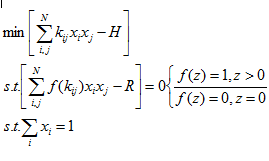
Please don't be put off by the maths at this stage, I am simply looking to set the scene, I will not be delving into equations, rather the concepts of solving a class of problems.  Essentially I had an equation something like:


with this example being a simplified version in 2 dimensions, the real problem I was tackling had 19 dimension, but the concept is the same.

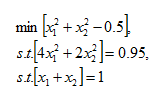
To give some real values to the problem for those of us who don't think in terms of pure mathematics, my simplest test scenario involved having a limit of N = 2 a matrix for k of


setting the values of H and R to be 0.5 and 0.95 respectively, we have


which on the face of it seems fairly straightforward.  Brute force should make it fairly easy to solve, it can be reduced to a one dimensional problem, and very basic techniques could be used to solve.  But without going to town on expanding the problem, imagine adding a third dimension, or simply increasing N to 3.

There are many techniques out there for solving such constrained non-linear minimisation problems, such as the use of Lagrange multipliers or numerical approaches like interior point interpolation.  However I was, and still am interested in whether using genetic algorithms could be a fruitful avenue of investigation for this category of problem.

Genetic algorithms have a number of advantages over purely mathematical approaches.  The problem of local minima being found being a key one, and from a computational point of view, the scalability of a GA approach drew me in.

What is a Genetic Algorithm

The idea behind a GS Approach is that given a problem that we have no idea of how to get to a good solution of, but where we know a good solution when we see it, we can explore the problem space finding progressively 'better' solutions until such a time as we are satisfied with the best solution tested.
In practice this means that we need to have a way to evaluate how 'good' a solution to the problem is.  For the problem described earlier, we need a way to determine if for a given set of x the solution is acceptable, and how good a solution it is.  As we have a constrained problem, only solutions for which the 2 constraint equations are satisfied are permissible.  A simple measure of how good each permissible solution is would be how far from 0 the minimisation part resolves to.
Given this ability to evaluate how good a solution is (known as the fitness of the solution) the algorithm needs a way to generate new potential solutions in an educated manner to find ever better solutions, and then to iterate this loop.

The term genetic algorithm takes its origins from Darwinian evolutionary theory.  A population of potential solutions exists, from which the fittest are selected, a further generation of solutions is born (variation in the population created via cross breeding and mutation), the weakest being culled, the fittest surviving, reproducing and evolving through the generations.

Given a broad enough initial population and sufficient generations, all corners of the problem space should be explored, with good, but not necessarily the best solutions not swamping out rarer but stronger strains.

Seems ideal?

Yes it does, calculating the fitness of a solution in this way is very fast and cheap.  The calculation of the fitness of any solution is an atomic process, so a huge population is not a problem as we can easily scale out.  So what is the problem and why aren't all mathematical problems approached this way?

One problem comes that a solution may be investigated that is a poor fit and discarded, another that is a fair but not excellent fit is returned in preference. over time we get a healthy population of fair solutions, but nothing good enough.  Through mutation an cross breeding we will always continue to explore new solutions until the algorithm exits, however the details of the breeding and mutation limit the ability to find an 'ideal' solution.

The mere fact that we have discarded any possibility of a solution that violates the constraint equations out of hand means that we may be ruling out entire sections of the problem space that could evolve to yield a better solution.

A post that explores the idea of constraints that tighten through the generations is here, and suggests that ruling out solutions early in the evolutionary process is a bad idea, with solutions that violate the constraints becoming less favourable in later generations, but in early generations having the opportunity to influence the overall population.

How to implement a GA in .NET

A very good question, you could spend years writing the evolution, mutation, breeding and selection code.  However, good news, there is a great framework that does the hard work for you, allowing you to concentrate on the problem you are really interested in.  Using GAF allows you to concentrate on evaluating the fitness of solutions, defining how the mutations occur and how breeding is performed.  With only the need to define 2 functions (evaluate the fitness of a solution and determine if we should stop evolving) you can solve a problem.  A good introduction to the framework is given here with examples of problems you can solve.

The specific functions I used for this problem are:

 private static double CalculateFitness(Chromosome solution)
        {
            var tol =1e-3;
            var unfit = 0;
            //need to calculate the proximity of the three equations to 0
            var sum = solution.Genes.Sum(x => x.RealValue);
            if (System.Math.Sqrt(System.Math.Pow(sum - 1, 2)) > tol) return unfit;
            if (GetDeltaR(solution.Genes.Select(x => x.RealValue)) > tol)
                return unfit;
            return 1d-(GetDeltaF(solution.Genes.Select(x => x.RealValue)));
        }

Where GetDeltaR and GetDeltaF calculate the difference between the result of the calculation and 0, the returned fitness is best at 1 and a solution is totally unfit if this evaluates to 0.

private static double GetDeltaF(IEnumerable<double> enumerable)
        {
            return System.Math.Sqrt(System.Math.Pow(GetF(enumerable) - TargetF, 2));
        }

        private static double GetDeltaR(IEnumerable<double> enumerable)
        {
            return System.Math.Sqrt(System.Math.Pow(GetR(enumerable)-TargetR, 2)); 

        }

and

private static bool Terminate(Population population, int currentGeneration, long currentEvaluation)
        {
            return  currentGeneration > 400;

        }

The decision to terminate is simply based on the number of generations here, only because experience has told me that this will not reach a solution where delta F is less than an acceptable level.

So it doesn't solve the problem?

Not as such.  With the fitness calculation above and the choice of breeding and mutation algorithms (I used the out of the box single point crossover breeding and swap mutation provided by GAF) a very good solution is not found.  However it does find a solution, and with some minor tweaks to only the fitness evaluation (taking into account the ideas of relaxed constraints in the linked article) a solution with R = 0.943 and F = 0.235 can be found in seconds.  Clearly this is not an ideal solution, but it is pretty good as a first stab.
For a problem such as this, the key to getting a good solution is choosing the correct mutation algorithm and breeding process.  The swap mutation used simply swaps round the elements of the solution, they do not 'vary', so a solution of (1,2) could mutate to (2,1) but could not become (1.1,1.9).  As we are dealing with continuous variables, the inability to mutate in this way will limit the proximity to the solution that we can get.
The crossover breeding takes 2 solutions, and uses part of each to produce a child solution (e.g. 1,2 and 3,4 could become 1,4)  which is acceptable given a suitable mutation and sufficient generations to explore all evolutionary branches.

I am interested in developing a new mutation algorithm that modifies the elements (termed genes in genetic algorithm circles) of the solution and will detail this process in a later blog.

Suffice to say with little effort using GA to solve a complex mathematical problem is a good way to go.  The effort to get a truly 'good' solution, may be a little greater, but to get a solution there is little effort.  I have previously attempted to solve the class of problems described here using interior point interpolation with some success, however the starting point of these interpolations is key to finding a good solution as they are very prone to finding local minima.  As such, a hybrid approach may be the answer, with GA selecting a range of potential starting points from which to interpolate rather than using either approach in isolation.